
S is for... Specificity, Sensemaking and Strategic Vagueness
And an upcoming workshop this Thursday!
Hello and welcome back to the alphabet series.
Sorry for the radio silence. Headspace for writing hasn’t been abundant these past few months. I’ve been deep in some fascinating client work, but interesting work doesn’t magically produce blog posts.
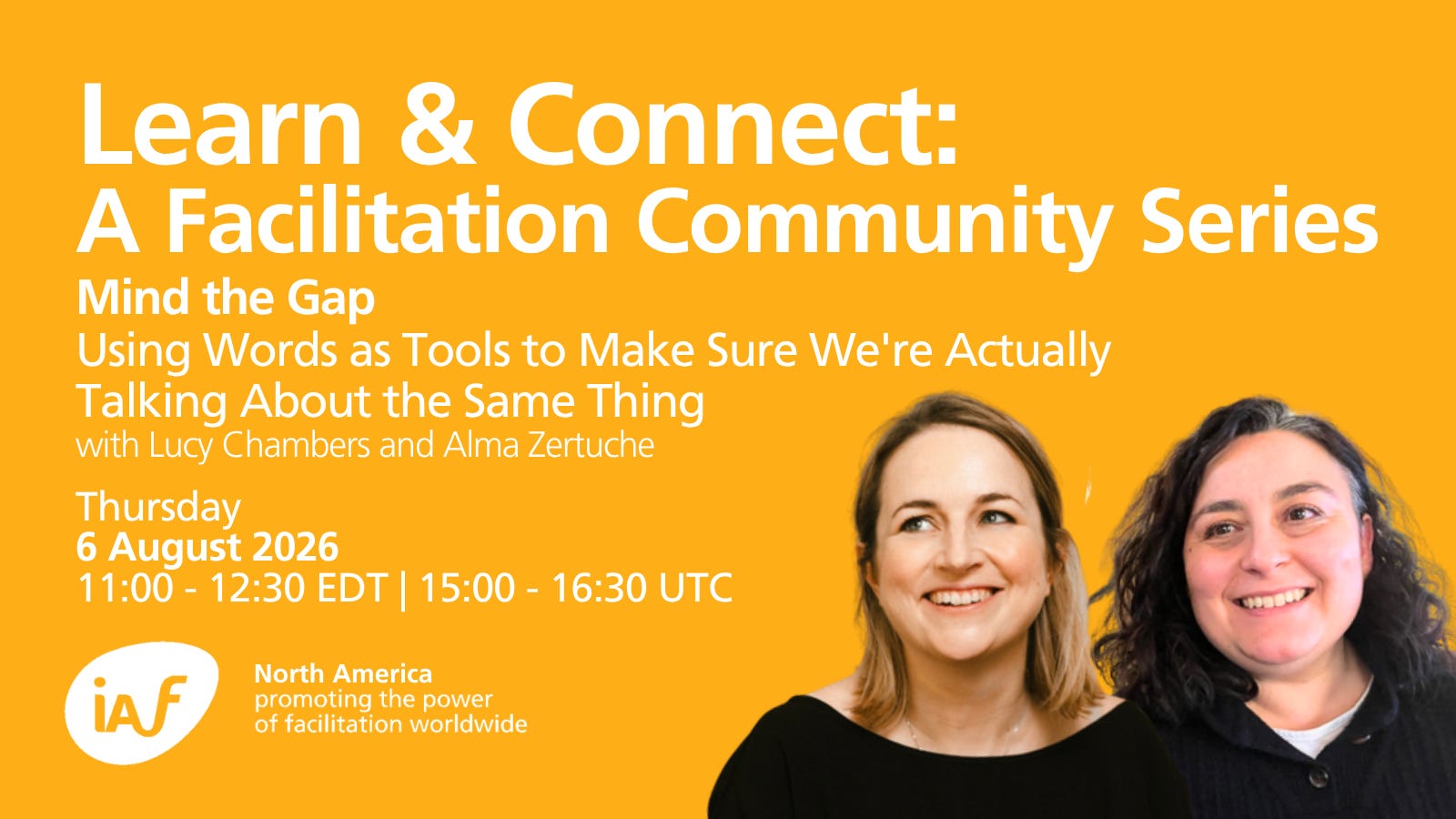
This week’s post is a little different. On Thursday @ 5pm CEST (see other timezones), my friend and collaborator Alma Zertuche and I are running a workshop on one of my favourite facilitation topics: how words shape the conversations we think we’re having. You can sign up here (it’s free).
Here’s a small appetiser.
Many of my clients are obsessed with action. If I had a Euro for every time I was told there have to be action items at the end of a session, I’d be a rich woman.
I get it. A series of endless meetings where no decisions are made and no actions are taken sucks. Action feels productive.
I’d challenge that, gently.
Action is important, but it’s not always the most important thing.
I’ve realised that a lot of my facilitation isn’t really about specific actions or decision-making at all. It’s about helping groups make sense of what we know or don’t know, and then helping them agree on what this information means. Only then do we decide what to do.
Looking back, I’d say 95% of the work I do falls into this category of “sensemaking” and as we become increasingly flooded with information and the speed of change accelerates, much more of this work is needed.
My favourite flow
One model I use as the backbone for almost every workshop I run is:
What → So What → Now What1
Everyone wants to get to the Now What (the decision or action)
But there’s very little point agreeing the Now What if we’re all talking about different Whats, or if we’re looking at the same facts but telling ourselves completely different stories about what they mean. So I don’t rush the What and So What stages.
If we need to get to Now What faster, let’s try something out, experiment and get more information to fuel the What and So What discussions. That is how better decisions are made.
Side note: I suspect I honed this instinct in tech, where being vague racks up a bill remarkably quickly. I’d happily bet no two people in history have ever meant exactly the same thing by the word “dashboard”.
From talking about plans to articulating which behaviours we want to change, most groups could do with being more specific.
Specificity can be uncomfortable. It forces us to discover that we weren’t as aligned as we thought we were. That’s exactly why it’s so valuable. I’d take ten uncomfortable minutes in a workshop over ten expensive weeks of people confidently pulling in different directions.
But wait… there’s a catch
If this post stopped here, it would just be another article telling you to be more specific. While I do think most groups would benefit from that, over the years I’ve realised there’s a second skill that’s just as important.
Knowing when to push for specificity... and when to help people move on.
I’ve watched groups disappear into a wordsmithing wormhole, debating the perfect definition of a word that didn’t actually need defining.
Sometimes asking “What exactly do you mean?” unlocks the conversation. Sometimes it’s the thing that kills the energy.
Specificity is a tool and, like any tool, it has an optimal time and a place.
Sometimes the ambiguity is the problem. Sometimes the ambiguity is doing useful work, giving the group enough room to explore before they need to commit.
Learning the difference is one of the hardest parts of facilitation.
The Mindset Shift
When I catch myself reaching for more specificity, I pause and ask:
What job is this ambiguity doing?
Is it hiding a misunderstanding?
Or is it giving the group room to think?
I don’t have a formula for answering that but I’ve found it’s a much more useful question than assuming every vague word needs pinning down.
P.S. In Thursday’s workshop you’ll learn a series of techniques for going beyond the question: “what does that mean?”.
You will leave with practical tools and a fresh appreciation for language as one of the most powerful instruments in a facilitator’s kit, tested on real examples from the group.
Here’s the signup link again.
Hat tip to Liberating Structures for this wording. I sometimes use the exercise, but it’s useful as an overarching flow too.