
M is for... Misanthrope
Dancing between “Most people are... shit”... and “People are all we’ve got”
🚩 Heads up - if you don’t approve of bad language, skip this post and come back next week ;)
🚩🚩 This post won’t be for everyone. I’ll respect you if you want to unsubscribe ➡️🚪Zero hard feelings.
But for those of you who resonate with this slightly more unpolished and unprofessional post, there is a little something at the bottom that might interest you.
This wasn’t the post I thought I would write this week. My original plan was to make M = “Messy”, but fate had another plan.
The quote in the subtitle comes from the British TV show Fleabag, a dark comedy about a woman whose life is a complete mess trying to figure out how to keep going.
So maybe this is about how to deal with mess after all?
Messy, complicated feelings about humans.
A quick definition
In case the word misanthrope is unfamiliar; a misanthrope is someone who dislikes people in general or has a low opinion of humanity as a whole.
Or in Fleabag terms, someone who thinks people are a bit “shit”.
In this post, we’ll deal with questions like:
How do we turn up and do our jobs if we think someone we work with is a “bit shit”?
How does our overall stance toward humanity show up in our work as facilitators?
How do we keep going when some humans really test our belief in the goodness of humans?
Complicated Feelings About Humans
As a person, I tend to see the best in people.
I’m generally pretty curious, patient and willing to gently encourage people to show their best sides, and to suspend judgment for long enough for more flattering aspects of their character to emerge.
But for a while now I’ve felt a limit to that patience; a dark underside I was reluctant to acknowledge publicly for fear of being judged by other facilitators as insufficiently neutral.
This feeling, and the idea for this post, has been brewing for a couple of years now. I’ve spent a lot of time around ideas like treating people with unconditional positive regard and people’s capacity to grow and change given the right circumstances.
And while I admire the intention behind these beliefs and in many cases wholeheartedly embrace them, I’ve had to acknowledge that my own feelings about humans are far messier.
I simply don’t believe everyone is willing or able to change or grow.
And after another year of humans being a bit shit on a global scale, it was a small moment this week, tiny against the backdrop of everything else, and yet one of those rare little moments you can actually hold, that finally tipped me over the edge and made me publish this.
What happened
I’ll spare you the details, but let’s just say that someone did something that deeply disappointed someone I love.
The event in question left us feeling like Machiavelli might have had a point when he said:
Any man who tries to be good all the time is bound to come to ruin among the great number who are not good.
Hence a prince who wants to keep his authority must learn how not to be good, and use that knowledge, or refrain from using it, as necessity requires.
- Niccolò Machiavelli
If Machiavelli is right, it’s bad news for me, and most people I care about whose conviction for doing the right thing, speaking truth to power and advocating for others often ends up getting them sidelined, punished or even fired.
And yet, despite all that, another more hopeful quote is rattling around in my head:
“The arc of the moral universe is long, but it bends toward justice.” - Martin Luther King, Jr
If MLK Jr is right, the real question becomes how we continue to show up, even when the bend seems far away and how we hold onto belief in humanity until it gets here.
A Book That Gets It
The reason I chose to write this post in the end was because I came across someone else who perfectly articulated what I am feeling:
I don’t have a hostile disposition toward humankind per se. In fact, I feel quite warmly toward humankind. It’s individual humans I have trouble with.
- Robert Wright - Why Buddhism is True 1
I picked up this book in Thailand last year not because I’m a Buddhist, but because I was sufficiently curious about what I’d heard.
Once I got past the title, which I initially found obnoxious for it’s claims about “truth”, I realised it is actually a science book exploring Buddhist principles through evolutionary psychology, examining whether they can be proven scientifically. It’s also surprisingly amusing and doesn’t take itself too seriously.
It helped me.
So what do I do with all of this?
If you are able to treat everyone with unconditional positive regard, I applaud you.
I have realised that for some people, I simply cannot make myself believe in their capacity for change. If I don’t believe in someone’s integrity, I cannot mask that. I have no poker face.
So I:
try not to put myself in situations where I don’t believe in people or their intentions from the outset.
co-facilitate where feasible, particularly to have other perspectives to help me assume positive intent for as long as possible.
channel my frustration into understanding my own triggers and refining how I facilitate, rather than forcing belief in people who don’t earn it.
The Mindset Shift:
I believe it’s possible to be a great facilitator without a universally positive regard for humanity.
Because while I believe that some individuals can be utter shits, I know that on balance there are more people who aren’t.
Luckily, most of the people who I consider irredeemable shits are the ones with a level of power that disconnects them from reality.
So we need to design groups, organisations and systems in ways that use the power of groups and collectives against those who are only serving their own interests.
Not in the hope of changing the minority of humanity who are shits, for that is futile. Rather in the hope that the majority of the population can realise that the shits do not have humanity’s best interests at heart, and that as individuals they are not alone in feeling this way or powerless to change it.
Because at the moment, there are lots of examples which seem to prove Machiavelli’s point, but there’s just enough of a spark of belief in me that he can be proven wrong for me to want to keep going.
From: You can’t be a good facilitator if you can’t hold humans in universally positive regard.
To: You don’t need to believe everyone is a saint to be a brilliant facilitator. If you can accept that the shits are statistically in the minority, you’re already halfway there.
Final words
Maybe, one day in the future, when I am wiser, and better able to practise whatever it is people more evolved than I do to stay calm in the face of life’s challenges, I will write a follow-up to this post and show how young and wrong I once was.
I look forward to that day. I hope it comes.
For now, I’m going to own the rage and explore ways that I can channel the energy it gives me to explore my own style of facilitation.
A style of facilitation that is important *because* some people are a bit shit.
Because if we allow those people who are a bit shit to surround themselves with other people who are a bit shit, and get more and more powerful, things are going to get a whole lot more shit for everyone.
As Belinda from Fleabag points out:
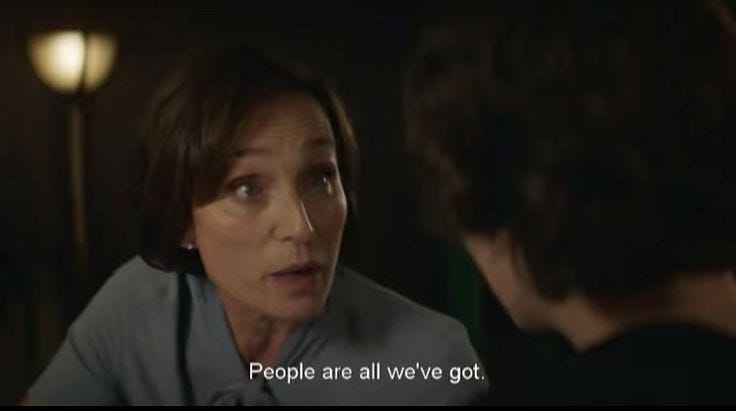
People are all we’ve got.
And as the quote continues…
So grab the night by its nipples and
go flirt with someonechannel the rage, sharpen your style, and don’t let the shit people win because there are a lot of people doing good out there and it’s your job to work out how to help them.
I may have taken some artistic liberties here…
Anyone still with me?
For those of you who made it to the end: Thank you and I appreciate you.
Up top, I hinted that I had something to offer for those of you who resonate with this more honest style of post.
In short, I’ve just launched a new Substack called Small. Scrappy. Sustainable. This one will be about the lessons I’ve learned and am learning about building a business.
Why and how does it connect to this post?
Remember how I said I “try not to put myself in situations where I don’t believe in people or their intentions from the outset.”
Well, one of the only ways I can do this is to give myself choices. Choices of clients, choices of business model. Because if we don’t have choices, we have to take shit work. Because capitalism.
And I want to help other people have that choice, because I believe in small businesses as a force for good.
I’ll introduce it to you over the coming weeks but if you are curious already, I just published the first post with an explainer of what is to come.

Thank you for tolerating the 15 times I said “shit” in this post (now 16). I now feel I have it out of my system for a while and will give you a break from it in the next post.
p.s. this is an affiliate link to Bookshop.org in the UK. If you want to start nudging the arc of justice - support independent bookshops rather than the giant platforms who don’t need your money.