
Q is for... Questions
Facilitator Einstein & the Power of the Stupid Question
Hello and welcome back to the alphabet series. This week, we are digging into a question which I was asked by a client: “How do I ask better questions?”
But first, a different question
Which questions are mine [as a facilitator] to ask?
This question was inspired by the blog post of a fellow facilitator friend, Ewen Le Borgne, who points out that actually, there are a lot of types of questions which aren’t a facilitator’s to ask.
Why?
Because [my paraphrase] facilitators often confuse their role in asking questions with that of a consultant or content expert and think their role is to ask clever or insightful questions about the topic at hand. It’s not.
Our job as facilitators is to help the group do its best thinking and maybe (depending on our mandate) to improve their process literacy to deal with similar challenges better in the future. Meddling in content questions usually undermines that task and makes the whole thing muddy.1
My hot take: a lot of the most helpful questions a facilitator can ask are not clever at all…
The power of the “stupid'“ question
I sometimes say that I have made an entire career out of being the one who was prepared to ask the stupid questions.
But “stupid” questions are paradoxically, not stupid at all.
They are just ones that many people don’t ask for fear of looking stupid.
I’ll stop putting them in inverted commas now but I’ll keep affectionately calling them stupid questions so that I don’t have to find another term for them.
Usually, stupid questions gently challenge something that people assume (usually incorrectly) everyone in the room already knows or has agreed on.
And that is where we as facilitators can use the power entrusted to us by the group to ask a stupid question to unlock something.
As an outside party, facilitators can often ask things that would be too risky for a participant to ask as it would risk revealing gaps in their knowledge or alignment.
And, by role-modelling asking these types of questions, we make visible how non self-evident the answers usually are. (This builds the group’s inclination to ask such questions in the future which serves them long after we are gone.)
Some of my all-time favourite stupid questions to ask as a facilitator are:
What does that mean (to you)?
Which question, if answered, would move us forward?
Are we answering the right question?
Using questions as workshop goals
Speaking of: “are we answering the right question?”
Besides the questions we ask as a facilitator, the other important type of question is the one which the group is working on such as “What do we need to get done next quarter?” or “What options are there to solve this problem?”
Pro tip: I’m a big fan of using questions in the framing of a meeting - particularly simple ones.
For example, if we look at just some things that “strategy workshop” could mean in terms of questions we get things like:
What do we want to win at and what will we ignore?
Where should we focus next to create the most impact?
If we could only do three things this year, what would they be?
What choices do we need to make now to succeed later?
What does “success” actually mean for us right now?
… and many more
I bet you that very few people will understand the same thing by “strategy workshop” but by picking questions to answer we check we are all likely talking about the same thing.
Facilitator Einstein Chimes in
So are we answering the right question in our sessions?
Einstein once said:
“If I had an hour to solve a problem and my life depended on the solution, I would spend the first 55 minutes determining the proper question to ask… for once I know the proper question, I could solve the problem in less than five minutes.”

We might not all have Einstein’s brain, but I think most of us could benefit from making a bit of the same tradeoff. In my experience many groups spend way too little time thinking about which questions they are answering and crucially, whether we all understand the same thing by the question.
And if a group isn’t asking right question, their answers are irrelevant.
Here are a few things to try to sharpen up those questions.
Question storming: like a brainstorm, but the only thing that people can contribute is questions. Here’s a great article on the approach.
Check people understand key words in the question. For questions that are central to your workshop: Write the question out and underline the assumptions or any words which might cause confusion and then have a discussion to clarify them. Iterate on the question before you dig in. This saves soooo much time (and potential, unnecessary conflicts) later!
Flip your question and ask the opposite. Sometimes you get a whole new perspective by asking the inverse of the question you think you need to ask. Here is one of my favourite pairs of questions:
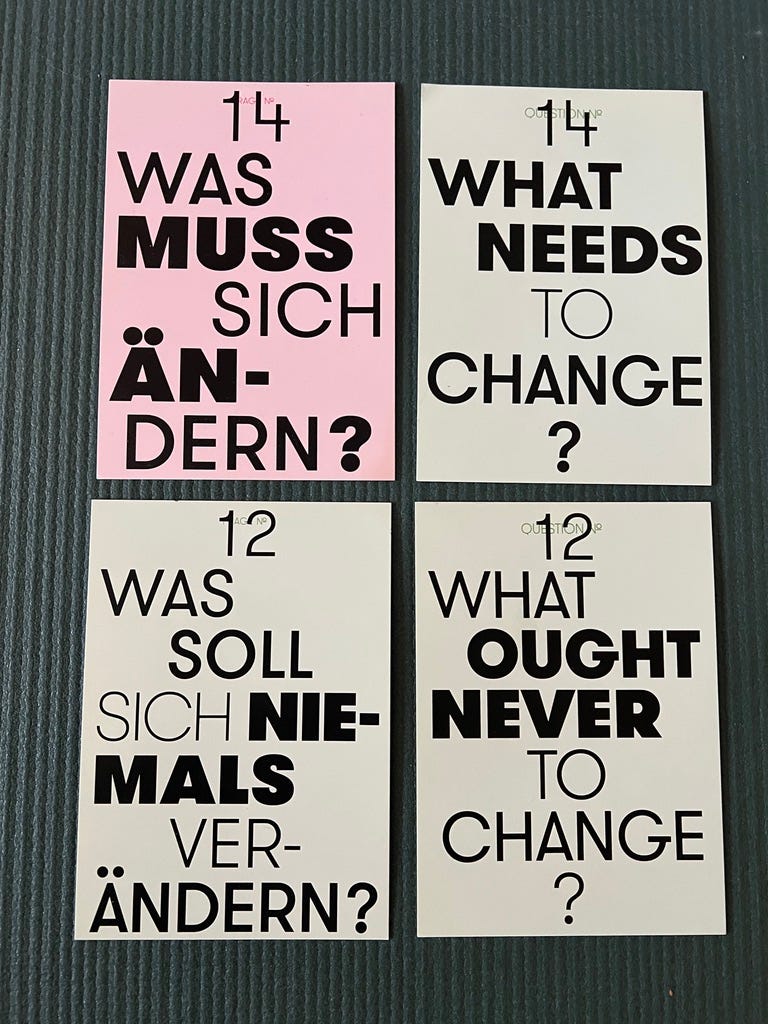
The Mindset Shift:
From: Facilitators should ask powerful, insightful questions about the topic they are dealing with.
To: Long live the “stupid” question and question the questions the group is asking.
p.s. Over on my other Substack, Small. Scrappy. Sustainable I just wrote a post to answer one of the most common questions I’ve been asked since starting a business: “How did you get your first clients?”. It’s behind the paywall but if you subscribe you should get a free one-post preview option if you want to read it. (Let me know if that doesn’t work and I’ll look into it).

p.p.s In other Q news. I’m also Questing at the moment as part of one of Channel twelve’s Creative Quests - if anyone has done one before, would love to hear about your experience!
Apart from that useful insight, I’m a big fan of the meta-questions and process questions in Ewen’s blog and recommend giving it a read, it’s a useful backdrop to what we are going to talk about today.